
Kirstie Ennis Knows the Healing Power of Connection & Community

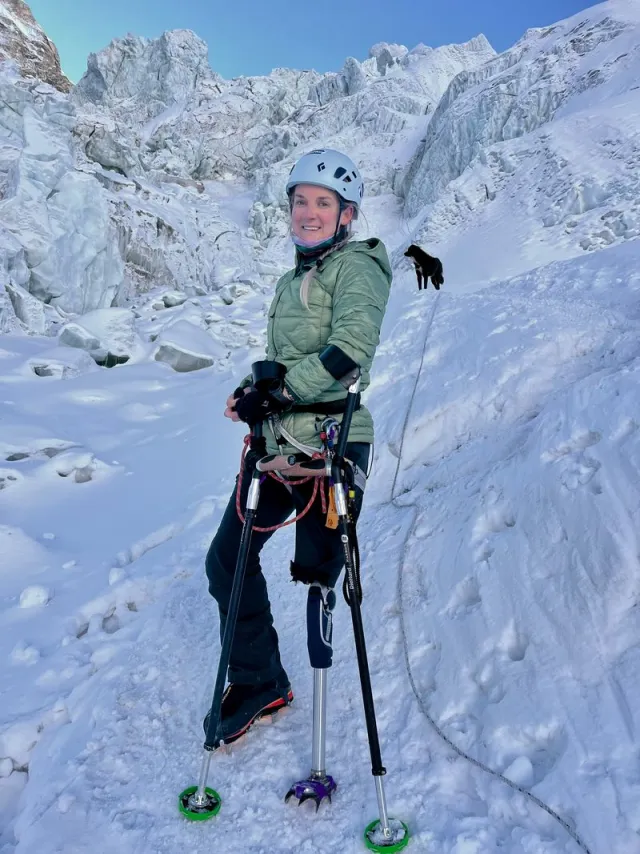
Kirstie, pictured on the summit of Mount Elbrus, Russia, in September 2018.
Kirstie leads a life defined by courage, service, and purpose, helping to build community for others when they need it most. This October, she’ll bring that spirit to the Marine Corps Marathon as CSC United’s Honored Hero.
I know how much connection, community, and collective support can mean when someone is hurting.
Some stories stay with you — and Kirstie’s is one of them. From a young age, she knew she wanted to follow in the footsteps of her parents, both of whom served in the U.S. Marine Corps. In 2008, at just 17 years old, she enlisted. Driven by her compassion for others, Kirstie’s mission was simple: To protect those who couldn’t protect themselves.
During her service, Kirstie’s commitment to her mission only deepened. That calling often placed her in dangerous situations. In 2012, the Marine Corps sergeant suffered life-threatening injuries in a helicopter crash in Afghanistan. Her recovery was long and grueling, requiring multiple surgeries in the years that followed, including the amputation of her left leg.
Today, through the Kirstie Ennis Foundation, she continues to lead a life of service, drawing purpose from her own experiences. Her foundation supports adaptive athletes and brings outdoor recreational therapy to underserved communities.
Kirstie shares more in this Q&A, including why she was inspired to accept CSC’s Honored Hero invitation.
Can you tell us a little bit about you and your story?
Both of my parents are Marines, and I looked up to them deeply. I wanted to be just like them. To me, wearing the uniform was like putting on a superhero cape. I finished high school by 15 and graduated at 17. A little too smart for my own good, I started getting into some trouble, and I decided to join the Marine Corps. I had known from an early age that was what I wanted to do.
My mom was ready to sign the paperwork right away. My dad was much more hesitant and flew home immediately. [In the end] I left my home in Pensacola, Florida, at 17 years old, in August 2008, and graduated from boot camp that November.
I’ve always had a deep love for people. I’m passionate and loyal. What I saw and endured overseas only strengthened my belief in protecting people who cannot protect themselves.
I care deeply about the military and veteran community. Life exposes us to so much, especially during service and in other countries. After traveling to all 7 continents, I’ve come to understand how important it is to raise awareness about what veterans face — both during active duty and as they work to rebuild their lives afterward. So, I’ve kept looking for diverse ways to serve.
Congratulations to you and your fiancée John on your recent engagement. How did you two meet?
I live in a unique part of the country, the Roaring Fork Valley. It’s a small town in western Colorado with a population of around 9,000 people. My fiancée John is an incredible athlete. He’s one of the best mountain bikers I know, he’s a volunteer wildfire firefighter, and he’s a snowboarder.
John began volunteering as one of the instructors for my nonprofit, the Kirstie Ennis Foundation, and he was amazing. We had known each other from moving in the same circles. Seeing the way he teaches, coaches, and cares for people felt special.
For anyone who is not familiar with your foundation, the Kirstie Ennis Foundation, how would you describe the heart of its mission?
The heart of my foundation is a way to give back. When I left the Marine Corps, I felt lost and wasn’t sure how to keep serving or find purpose in a completely different world. All I wanted was to give back and create opportunities for people who might be feeling the same way. And that’s what I did.
It started with mountain climbing, fundraising, and creating grant opportunities for like-minded organizations that were creating healing in the outdoors. Over time, it evolved into creating the recreational therapy clinics I now run. It's all about building community and a means just to be able to communicate. You might be hurting, you might feel different, or going through some stuff, but you’ll always have someone there who has your back.
Another major pillar of our work is collecting medical equipment, whether prosthetics or wheelchairs, and redistributing it around the country and the world.
For me, the mission is about creating opportunities for people to feel whole again, reconnect with themselves, and regain independence. That’s what the outdoors gave me. So, I wanted to make sure that other people could do that. We have an incredible alumni community that returns every year and continues to give back in meaningful ways.
Outdoor therapy played a key role in your recovery. In what ways does it remain therapeutic for you now?
I don’t believe veterans always get better by sitting across from a therapist who has only read about their experiences and never lived through them. I’m not prescribing anything, but I do believe in getting outside, moving your body, and appreciating what you have.
I thank God every day that I can see, I can use my eyes, and I am not paralyzed. I use a wheelchair often, but I can still do so many things. That’s why the outdoors feel therapeutic to me now. It’s not dramatic — it’s simple: I still can, and I’m going to keep doing it. When you do that, you start to put the pieces back together.
Why were you inspired to accept CSC’s Honored Hero role?
I was honored to accept it because of the enthusiasm behind it. I know how much connection, community, and collective support can mean when someone is hurting.
The truth is, all of us will face illness, disability, or loss at some point. How wonderful is it to know that people will rally around you, even when you feel so alone? When I looked further into CSC’s mission, gosh, I’m here for it.
At any moment, me, my mom, my dad, or someone else close to me could be diagnosed with cancer. Knowing there are people doing something so meaningful — especially for military families — made it impossible for me to stay away.
Join Kirstie & CSC United
We're headed to the Marine Corps Marathon® on Oct. 25 — and we’re recruiting our first-ever team of runners. We are looking for people like YOU. Run the MCM with Kirstie to ensure no one faces cancer alone.
Do you have any mantras or tricks that help you persevere through marathons and other endurance sports?
My mantras are actually tattooed all over me — two are on my wrists. One says, “Die living.” The other says, “Teeth to the wind."
“Die living” became meaningful to me while I was climbing Carstensz in Indonesia in 2017.
“Teeth to the wind” isn’t meant to sound cool. It’s something that a climbing partner — whom I recently lost — and I used to say all the time. It means you smile and keep working through whatever comes, no matter what. That’s what we do.
And the biggest mantra for me has always been: “It’s what’s six inches between your ears and what’s behind your rib cage. As long as your head and your heart are in the right place, everything will be okay.”
What would you say to others who are thinking about joining Team CSC United in the Marine Corps Marathon?
It’s an incredible run. There’s something special about seeing so many people out there happy to run a marathon. The crowd support, the history of the race, and the course itself is unreal. Thankfully, the course is flat, but it’s so lovely, and everyone is there to have fun and cheer each other on. People of all abilities come together to support a great cause and rally around one another. That kind of unity is something we really need right now in a world that is so divided.
Do you have any advice you’d like to share with people who are facing a life-changing cancer diagnosis or a long road to recovery?
Recovery can feel incredibly lonely, and sometimes it won’t make sense. But don’t let feelings of loneliness convince you that you are alone. There are so many people who love you and are rooting for you. Life changes are hard, but we get through them by remembering that there is always going to be a community there for us.
Become an Advocate
Stand up for healthcare policies that improve lives and care coverage for patients, survivors, and caregivers.
Share Your Story
Just a few heartfelt words, shared through writing or video, may help someone facing cancer take their next step with hope.