

Meaningful Change in the Ability to Do Activities With Cancer Cachexia
Presented at the American Association for Cancer Research Annual Conference
April 25-30, 2025 | Chicago, IL
Introduction
Cachexia is a multifactorial, multi-organ syndrome with ongoing loss of skeletal muscle mass (with or without the loss of fat mass), resulting in subsequent weight loss as well as fatigue, that is one of the main causes of morbidity and mortality in late stages of chronic conditions such as cancer. The ongoing weight loss, loss of skeletal muscle, and physical fatigue results in progressive functional impairment, including reduced physical activity/function limiting activities of daily living.
In a recent Phase 2 clinical trial, patients with cancer and cachexia had increased DHT-derived physical activity following 12 weeks of ponsegromab (400 mg, Q4W) as compared to placebo (increase in nonsedentary physical activity: 71.7 min/day modeled mean difference from placebo).
DHTs can quantify changes in physical activity in cachexia clinical studies. But what is a meaningful change to patients with cachexia and cancer? We estimated the meaningfulness of incremental changes in ability to perform physical activities of different intensity and time spent each day doing non-sedentary activity that can be measured with DHTs.
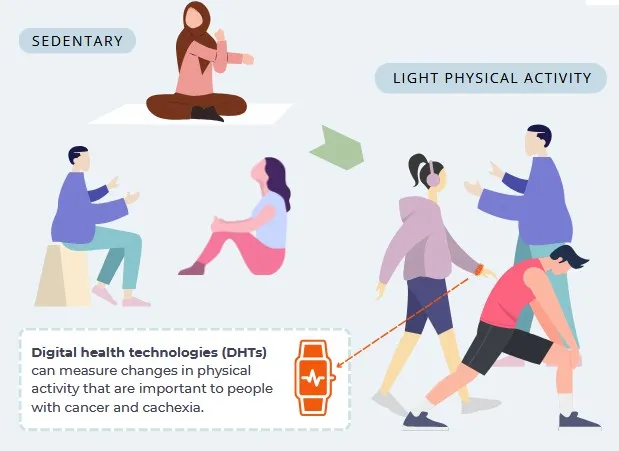
Digital health technologies (DHTs) can measure the types of activities important to patients. So, healthcare providers can use DHTs to see changes in what matters to patients. But what is a meaningful change to patients with cachexia and cancer? In this study, we estimated the meaningfulness of incremental changes in ability to perform physical activities, of different intensity and time, that can be measured with DHTs.
This study was sponsored by Pfizer.
Authors
Carrie Northcott1, Abigail Newell2, Soohyun Hwang3, Josh Coulter4, Lewis Kopenhafer3, Mar Santamaria5, Isik Karahanoglu5, Martine C. Maculaitis3, Joseph C. Cappelleri1, Kathleen Beusterien3, Maria Gonzalo2, Erica Fortune2, Claire Saxton2, Elif Andac-Jones6, and Brett Hauber4
1 Pfizer Inc, Groton, CT, USA
2 Cancer Support Community, Washington, DC, USA
3 Oracle Life Sciences, Austin, TX, USA
4 Pfizer Inc, New York, NY, USA
5 Pfizer Inc, Cambridge, MA, USA
6 Tigerlily Foundation, Washington, DC, USA
Methods
A cross-sectional online survey was conducted among US adults (≥18 years) with cancer and cachexia. Participants had to report unintentional weight loss consistent with the following criteria: (a) report lowest weight since cancer diagnosis or within past six months (whichever was shorter); and (b) have a calculated weight loss greater than 5% over past six months or since cancer diagnosis (whichever was shorter).
Activities included in the survey were identified based on a review of existing qualitative and quantitative data. Meaningfulness of 14 changes in ability to perform physical activities and 3 increases in daily time spent in non-sedentary activity were assessed on a 5-point rating scale (not at all meaningful to extremely meaningful). Subgroups (tumor type, cancer stage, self-reported ECOG performance status [PS]) were compared using chi-square tests (or Fisher’s exact tests for sparse data in which observed cell counts were <5).
Results
In total, 181 patients with cancer and cachexia participated [tumor types: breast n=69 (38.1%), colorectal n=30 (16.6%), non-small cell lung n=20 (11.0%), pancreatic n=15 (8.3%), other solid tumors n=47 (26.0%); stage: I-III n=123 (68.0%), IV n=52 (28.7%), don’t recall/not sure n=6 (3.3%); higher performance status (n=147) [self-reported ECOG PS of 1 (14.4%) and 2 (66.9%], lower self-reported performance status PS of 3, n=34 (18.8%)].
All changes in physical activity intensity, and both a 14-min and a 30-min increase in time spent in non-sedentary activity/day, were at least moderately meaningful to most patients, regardless of tumor type, cancer stage, or patient reported ECOG PS. Some meaningfulness ratings differed significantly by tumor type (both walking pace and distance were less meaningful in NSCLC and sitting to standing was less meaningful in pancreatic) and self-reported performance status (walking pace was less meaningful in patients with self-reported ECOG PS 3). Majorities of patients (60.9% to 86.7%), except for those with colorectal cancer (48.1%), rated a 4-min increase/day in non-sedentary activity as at least moderately meaningful.
Conclusions
Patients with cancer and cachexia perceived even small changes in physical activities and time spent in non-sedentary activity (as little as a +4 minute improvement) as being at least moderately meaningful, suggesting that DHTs that measure changes in movement duration can be used to capture important patient-centric endpoints in clinical studies.
Questions About This Research?
If you'd like more information about this study, or CSC's other research work, send us an email.
Related CSC Resources
Discover more about our work to understand and share information with our community about cancer cachexia and its impact on people living with the condition.
Understanding Cancer Cachexia
For patients and their loved ones to learn about cachexia, signs & symptoms, nutritional concerns, and ways to cope with the condition.
Cachexia: A Guide For Providers
Designed to facilitate conversations about cachexia with patients; includes a summary of the latest cachexia research.
Voice of the Patient Report
A follow-up report to our Externally Led Patient Focused Drug Development Meeting, capturing the experiences of living with cachexia.
Keywords
cachexia cancer patients digital health technologiesfatigue physical activity muscle loss weight loss